
Eleven weeks before the parliamentary elections, the Minerva Institute's latest representative telephone survey conducted by artificial intelligence shows a strengthening of previous trends. The Tisza Party has not only maintained but, beyond the margin of error, increased its advantage over the governing party, while the data project a clearly two-party parliament. It also emerged that Hungarians would remain in the EU, fear violence following the election results, and would link voting rights to additional conditions - primarily education-related.
Based on the measurement conducted in the third week of January, electoral participation willingness continues to be exceptionally high (83% say they are certain to participate). Even accounting for expected further mobilization, record turnout is expected.
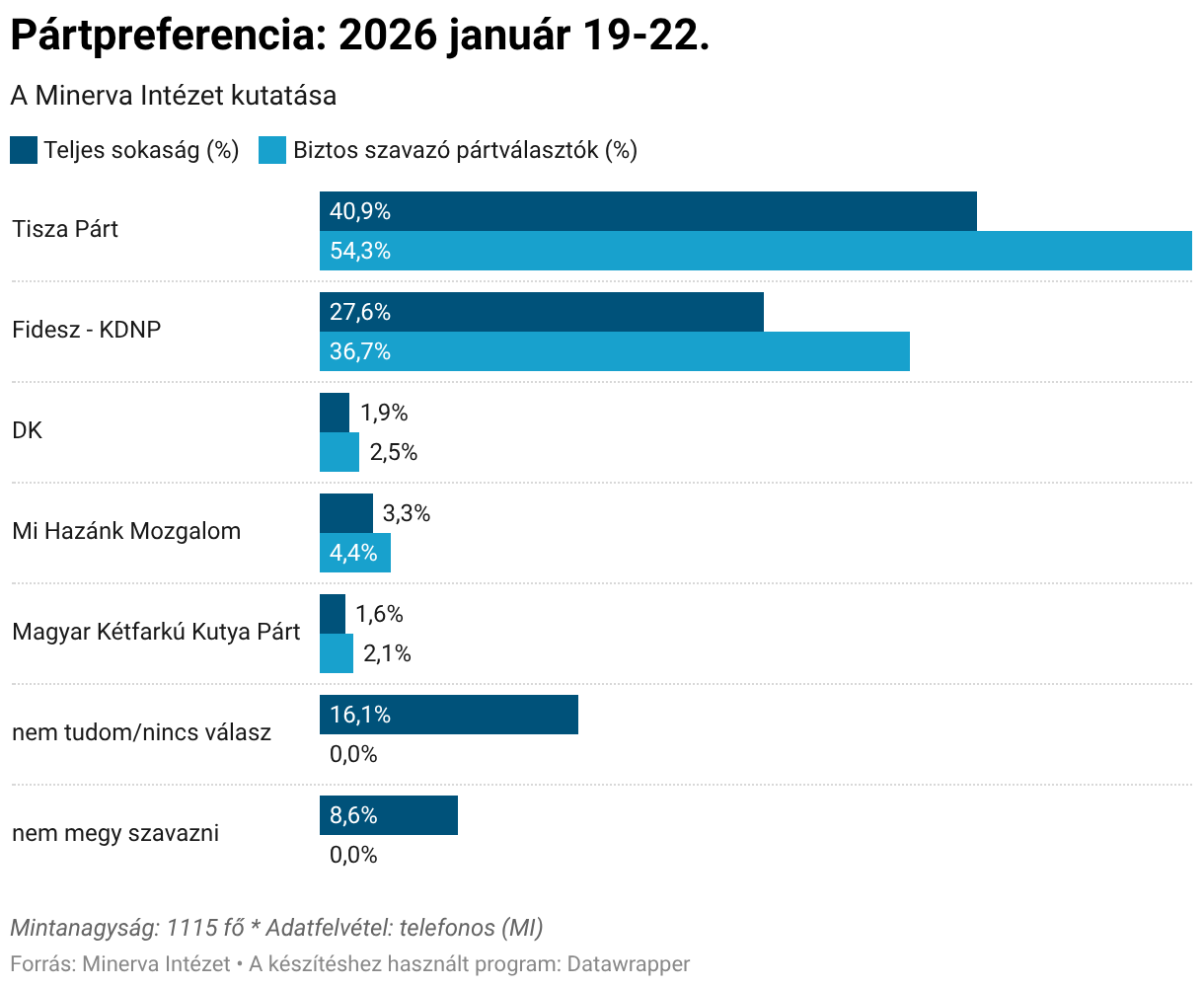
One of the most important demographic turning points of the survey is that, compared to autumn data, Tisza Party has now taken the lead among women (39% - 34%). While Fidesz still dominates in small settlements (40-36), a shift in public mood is indicated by the fact that a relative majority of voters (39%) would now bet on Tisza victory, compared to those who predict Fidesz success (34%) - this has also reversed from previous survey results. Similarly favoring Tisza, respondents' perception of their own environment has also changed: now 8 percentage points more people think their neighborhood is Tisza-leaning than those who suspect a Fidesz voter behind the next door.
Public opinion of the Prime Minister shows a steadily declining trend: over the past three months, the proportion of those wanting Viktor Orbán to step down has continuously increased. Currently, 45% of respondents do not want him to remain as Prime Minister (this was only 41% in November), while only 34% support his continuation. Among voters planning to vote but uncertain about their choice, twice as many would support the Prime Minister's departure as would support his remaining.
The data also reveal one source of the Tisza Party's growth. Of current Tisza voters, 12% claim to have voted for Fidesz in 2022. Another 22% "don't remember" or don't respond about their previous preference, which presumably covers additional hidden former governing party voters. This confirms that the opposition party has successfully appealed not only to the former opposition base but also to part of the governing party's voter base.
The survey also examined voter attitudes on three key topics:
1. EU membership: Support for Hungary's EU membership is unbroken, with no demographic group where the proportion wanting to remain has fallen below 70%. However, party preference shows a sharp distinction here: while this proportion is 93% among Tisza voters, it is 62% in the Fidesz camp who view it as a national interest. It is important to note, however, that among Fidesz voters, only 19% support EU withdrawal.

2. Stricter voting requirements: Surprisingly high support of 55% exists for stricter voting requirements, particularly among young people and Tisza voters (68%). Most people (37%) would tie voting rights to some form of education or knowledge test (e.g., school qualifications, IQ test), while 19% would somehow examine whether the voter lives in the country.


3. Fear of violence: A concerning finding is that 46% of voters consider it conceivable that the election result will lead to violence. This scenario is viewed as a realistic danger by 58% of Tisza and other party voters, while 35% of Fidesz voters consider it likely.
The Minerva Institute conducts telephone public opinion surveys using automated artificial intelligence voice assistants. The survey conducted between January 19-22 was conducted as an independent research institute without a client, pursuing its own professional goals. The survey collected a total of 2,653 fully completed questionnaires, from which a representative sample of 1,115 respondents was randomly selected and proportionally reduced for age groups, gender, and settlement type.
The Minerva Institute's primary goal is to renew research methodology through automated data collection. The Minerva Institute does not intend to become another public opinion research organization, so it does not publish comprehensive analyses, but makes the survey results database available to everyone on its website.
The survey can be further analyzed freely:
▶ Questions
▶ Response database (XLSX)
▶ WEIGHTED response database (XLSX)
▶ Analysis results (XLSX)
▶ Analysis results - WEIGHTED, frequencies (XLSX)
▶ Research methodology