
Public sentiment remains poor even among Fidesz voters, while willingness to participate in parliamentary elections is exceptionally high. The problems identified by respondents are not the same as what the government's rhetoric would emphasize: we don't fear war, we don't blame the international situation, while the cost of living and inflation press on almost everyone, and the state of healthcare weighs on many. Respondents under 60 would choose the Tisza party, while older respondents would choose Fidesz in greater numbers, but 18% only know they will go to vote, not who they will vote for.
The Minerva Institute conducts its telephone public opinion polls using an artificial intelligence-based robot assistant – respondents overwhelmingly perceived this solution as neutral, unusual or expressly positive, with only 18% reporting negative experiences. The survey conducted between September 23 and 25 was conducted as an independent research institute – without a client, according to its own professional objectives – to assess the current general mood of the Hungarian population and expectations about the future, while mapping how these feelings and opinions are distributed among different demographic groups depending on party preference.
The Minerva Institute's primary goal is to innovate research methodology through AI-based data collection. Since this approach involves methodological experimentation, it is a natural consequence that the results of the first few data collections may be characterized by somewhat greater uncertainty and variance compared to hybrid (telephone and web) research procedures. The Minerva Institute does not intend to become another public opinion polling organization, so it does not publish comprehensive analyses, but makes the results database available to anyone on its website. However, it is worth highlighting a few interesting points from the results of the fresh survey – these can provide footholds for understanding the current social mood.
Like every Minerva survey, this one tried to shed light on a topical question, this time awareness of the 3% loan. The Home Start appears to have been promoted quite successfully according to the answers, as 91% of respondents had heard of it, yet only 2.6% plan to use it, while a further 9.3% are considering the option. Interest is slightly higher among government party voters. Among age groups, naturally the youngest are most open to the option, while interest declines steadily from the capital to the countryside when broken down by settlement type.
In the general population, in age groups under 60, and among people living in all settlement types, the Tisza party leads according to the survey results, only those over 60 would vote twice as much for Fidesz as for Tisza. According to respondents, the outcome of the election will be decided by the state of the economy and people's financial situation – they do not expect significant impact from electoral fraud, war, migration or political scandals.
75 percent of respondents said they would certainly participate in parliamentary elections if held this coming Sunday. This is a rather high proportion, which can partly be explained by the likely high correlation between response willingness and voting activity.
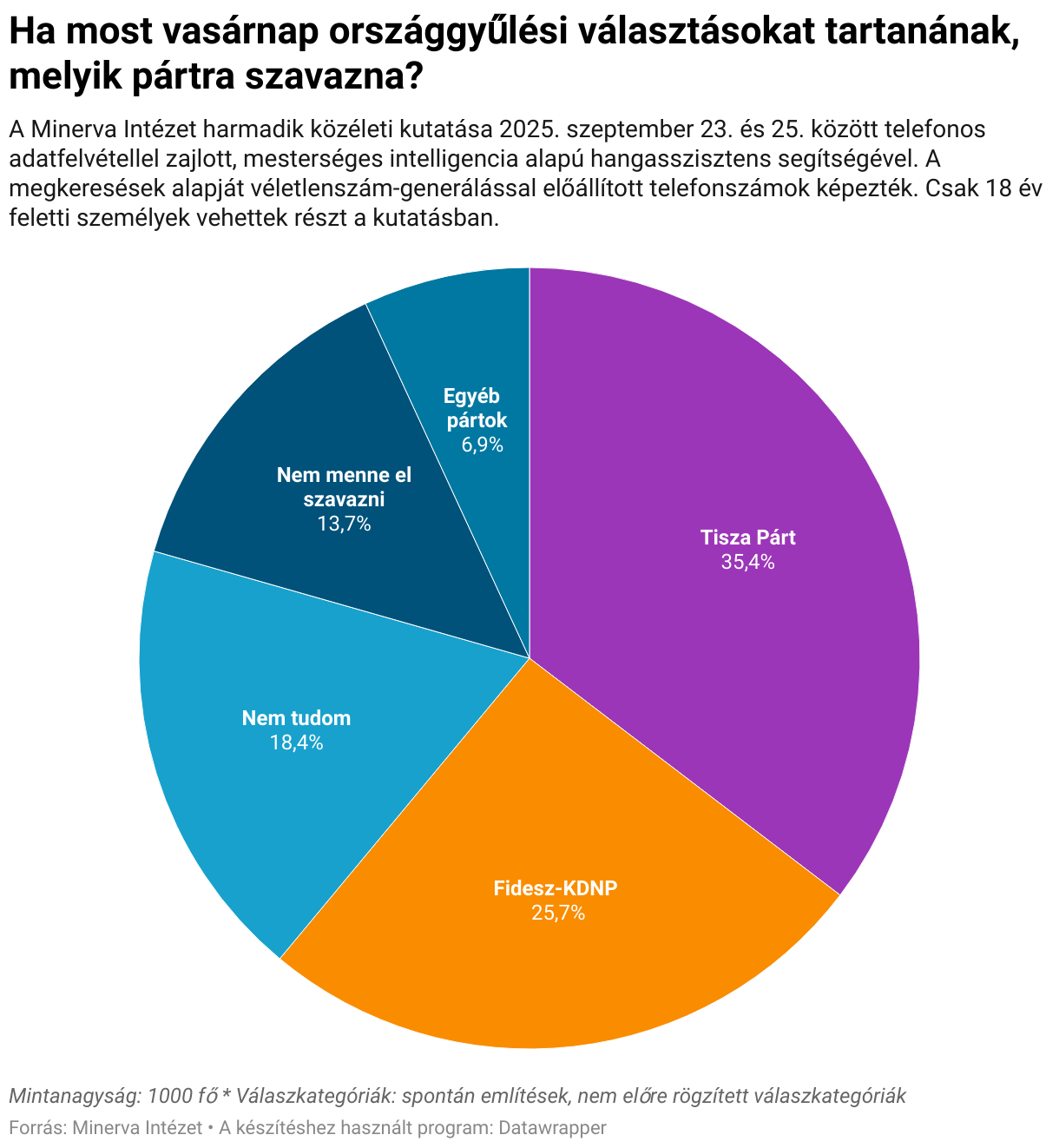
35 percent of all survey respondents would vote for the Tisza party, 26 percent for Fidesz, 7 percent for another party, 18 percent did not choose a party, while 14 percent of respondents would definitely not go to vote. Even accounting for methodological limitations, it can be stated that Tisza clearly leads among the parties.
This advantage, moreover, is evident in all settlement types: in the capital there is a 20 percentage point difference, in county towns 14, in cities 6 percentage points difference, while in smaller settlements the support for both parties is essentially equal (31-31%).
According to the data, Fidesz is characteristically the choice of older people: in the 60+ age group, twice as many would vote for this party (half of those voting for the party) as for Tisza, while in other age groups Tisza has an overwhelming majority – among them older people make up only 18%.
As for gender distribution, it is interesting that compared to the Minerva Institute's mid-summer survey, Tisza improved its results among women by almost 5 percentage points at the expense of men. It is merely a sociological curiosity that among those who would not go to vote or do not know who they would vote for, there are proportionally considerably more women than in the population.
It may be important that 93 percent of respondents who did not choose a party would definitely or probably go to vote. This nearly one-fifth politically active but still undecided or evasive voter group could have decisive influence on the election.
Respondents characterized four politicians in their own words: Viktor Orban, Peter Magyar, Donald Trump and Vladimir Putin – responses were categorized by AI. Both Hungarian politicians received 28% positive characterization from respondents, while the prime minister leads in negative opinions (50% compared to the Tisza leader's 38% result). A small proportion of their own voters (6-8%) judge both politicians negatively, however, a larger proportion of Tisza voters mention Magyar positively than Fidesz voters mention Orban (78% compared to 66%). The prime minister's criticism is primarily of a moral nature, while his virtue is mentioned as his competence, which is also valued as a positive attribute by his main challenger, in contrast to his personality. Trump and Putin show very low positive descriptors, mostly coming from Fidesz supporters. Interestingly, their negative judgment is equally high, 47 and 49 percent respectively.
In our September survey, we also asked respondents which topics they think will play the most important role in the final outcome of the election. 21% believe it will depend on the state of the economy, and 16% consider people's own financial situation the most important factor influencing the election. Only 1.6% fear decisive impact from electoral fraud, rather more mention discontent, propaganda and war (over 7%). Finally, a surprising fact: 48% believe the losing side will not accept defeat, and among them the relative majority (49%) think of Fidesz, while 24% think of Tisza.
One of the most striking results of the survey is that the assessment of public mood shows little variation between different social groups, however, compared to the summer survey, there is generally visible improvement of a few percentage points, primarily thanks to Fidesz voters. The overwhelming majority of respondents* – about 76 percent – rather see the public mood as bad, almost regardless of age, gender, education or type of settlement.
Of course, this value is certainly not independent of which party one plans to vote for, as Tisza and other opposition party voters feel 80-90% that the mood is bad, while "only" 42% of government party supporters believe we are not feeling well.
Similar levels of agreement were shown in what determines public mood the most: half of respondents (49%) named politics as the primary factor. Far fewer mentioned the economy (15%) or the individual responsibility of society members (10%). When broken down by party preference, of course large differences emerge here too: among Fidesz voters, politics and the economy run neck and neck, while Tisza supporters overwhelmingly (74%) highlight politics.
Respondents identified two main themes as Hungary's biggest problems*, in roughly equal proportions: 23 percent cited corruption, while 18 percent cited cost of living difficulties. More interesting, however, is that one-third of government party voters did not answer this question, the rest mainly citing social division and cost of living difficulties, while Tisza supporters cite 43% government criticism alongside the same poverty and division concerns.
Questions about daily life difficulties show poor prospects with little difference from summer survey results, whether examining inflation impacts or healthcare, so there is no significant change in this regard. Similarly, faith in the future developed as in summer: two-thirds of respondents do not fear war, 40% believe they have enough savings for unexpected expenses, and youth's prospects are judged equally good or bad – these better values are fueled by the much more optimistic answers of Fidesz supporters.
Questions about material situation showed marked differences along party preference lines. With the statement "the cost of living is a problem," 75% of the total population rather agrees, but when broken down by party preference this means only 46% of government party voters, while 97% of Tisza supporters. 18% of respondents believe there is no such problem – but they are almost entirely Fidesz supporters. These values have changed little since the summer survey, however, in another question where we asked about shopping burdens, 5% fewer today feel this is a problem – the proportion of those who perceive it rather as a problem decreased from 90 to 85%.
25% of respondents trust public healthcare (as in summer), but here too there is a big difference depending on political party preference: half of Fidesz supporters, while only 5% of Tisza supporters, believe they would be in good hands.
Finally, we asked how likely it is there would be war in our country in the next five years? 63% believe there is little chance – however, the 21% who believe there could be war shows completely balanced distribution depending on party preference.
The questionnaire survey was conducted between September 23 and 25, 2025. Respondents were reached by calling randomly generated mobile telephone numbers, and the AI assistant conducting the conversation clearly signaled its robot nature at the beginning of the call. The 1,000-person sample of those 18 and older was statistically weighted based on KSH's 2022 census data, taking into account distribution by gender and age.
Due to the nature of the method – as with all random telephone surveys – the sample cannot be considered fully representative. The response willingness of age groups under 60 was lower, so the proportion of older people in the sample is higher than in reality. We corrected for this through weighting, but it is important to emphasize that distortion of this magnitude can only be partially remedied by statistical tools. The survey results therefore primarily shed light on the directions of changes in social mood and opinions, rather than providing an accurate mapping of the entire population.
*: Weighted by age and gender
The survey can be analyzed further as needed:
▶ Response database (XLSX)
▶ Cross-tabulations (XLSX)
▶ Research methodology